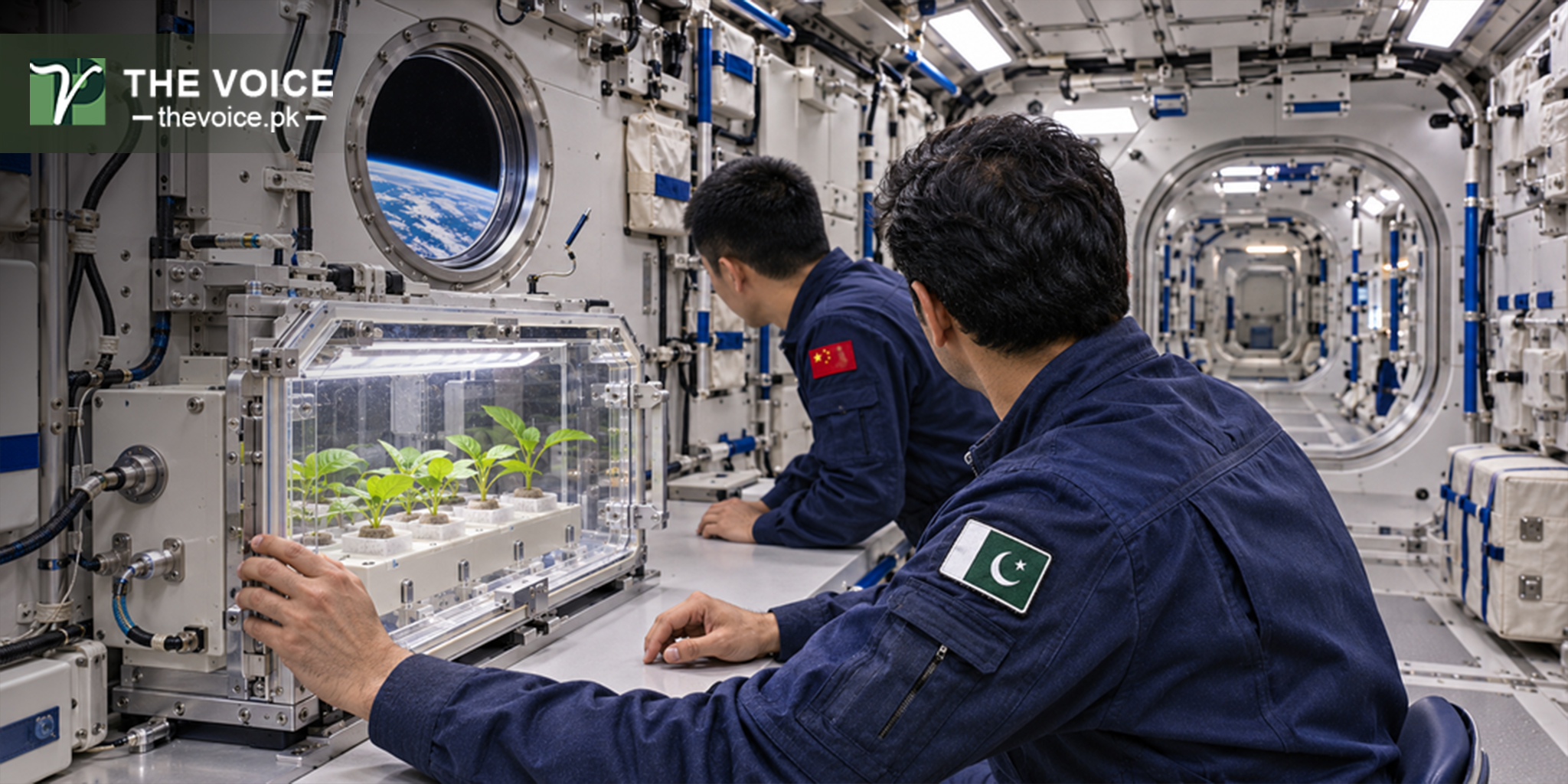
A Pakistani astronaut is set to join China’s Shenzhou-24 mission, becoming the first foreign national to visit its Tiangong space station. The development marks an important milestone in Pakistan’s space programme and its growing scientific partnership with China.
From a 2025 Agreement to a Historic Spaceflight
Pakistan is preparing for a historic milestone: an astronaut is set to travel to China’s Tiangong space station aboard the Shenzhou-24 mission. China’s Manned Space Agency says the Pakistani will serve as a payload specialist and become the first foreign national to visit Tiangong during a crewed mission.
The astronaut’s name and launch date have not been announced by Beijing. The two candidates named for training are pilots Muhammad Zeeshan Ali and Khurram Daud. They were selected after medical, psychological and aptitude screening, then sent for advanced training in China. A Pakistani government announcement in October had pointed to November 25, but China’s latest update has not confirmed that date. The astronaut is expected to return aboard the Shenzhou-23 spacecraft after a short stay in orbit.
The mission follows a cooperation agreement signed in February 2025 between Pakistan’s Space and Upper Atmosphere Research Commission (SUPARCO) and the China Manned Space Agency. Under it, two Pakistani candidates would train in China and one would be selected to conduct scientific work aboard the station.
The astronaut will work as a payload specialist, focusing on experiments rather than commanding the spacecraft. Research includes biotechnology experiments on food security and climate change. This could give Pakistani researchers experience in designing experiments for microgravity.
Pakistan’s Space Programme Is Growing
Pakistan’s space programme began with SUPARCO’s establishment in 1961. Its first indigenous satellite, Badr-1, was launched in 1990 aboard a Chinese rocket. Since then, Pakistan has expanded satellite work in communications, earth observation and remote sensing.
Recent milestones include EO-1, launched in January 2025; the PRSC-S1 radar satellite, launched in July 2025; and EO-2, launched in February 2026. These systems support agriculture, urban planning, resource management and disaster response. Pakistan is also developing a lunar rover for China’s Chang’e-8 mission, planned for 2028.
What the Mission Could Mean for Pakistan
The astronaut flight will not mean Pakistan has developed an independent human spaceflight system. The launch, spacecraft, training and return will rely on China’s facilities and expertise. However, the mission can give Pakistani scientists and engineers experience, strengthen cooperation with Chinese institutions and encourage young people to study science and technology.
Its longer-term value will depend on what Pakistan builds at home: stronger laboratories, sustained research funding, local satellite and instrument development, and opportunities for trained specialists to continue working in the country. A lasting space programme requires investment beyond one flight.
References
https://www.reuters.com/science/pakistani-astronaut-join-china-space-stations-shenzhou-24-mission-2026-11-07
https://www.geo.tv/latest/690123-pakistani-astronaut-to-join-china-space-stations-shenzhou-24-mission